

With the increasing demand for higher coating quality, production consistency, and intelligent management in electroplating industries, traditional analog rectifiers are gradually being replaced by digitally controlled power supplies. Rectifiers integrating a CPU control system, HMI interface, and RS485 communication have become an important solution for modern electroplating lines.
Precise Process Control with CPU-Based Regulation
At the core of this type of rectifier is a CPU control unit, which enables accurate regulation of output voltage and current. In electroplating, even minor fluctuations in electrical parameters can affect coating thickness, adhesion, and surface uniformity. The CPU continuously monitors real-time operating data and performs rapid adjustments, ensuring stable output under varying load conditions.
This closed-loop control capability is especially valuable for processes such as copper, nickel, chromium, and zinc plating, where different stages may require different current densities. The CPU allows multiple plating programs to be stored and executed automatically, reducing operator dependence and minimizing human error.
HMI for Intuitive Operation and Process Visualization
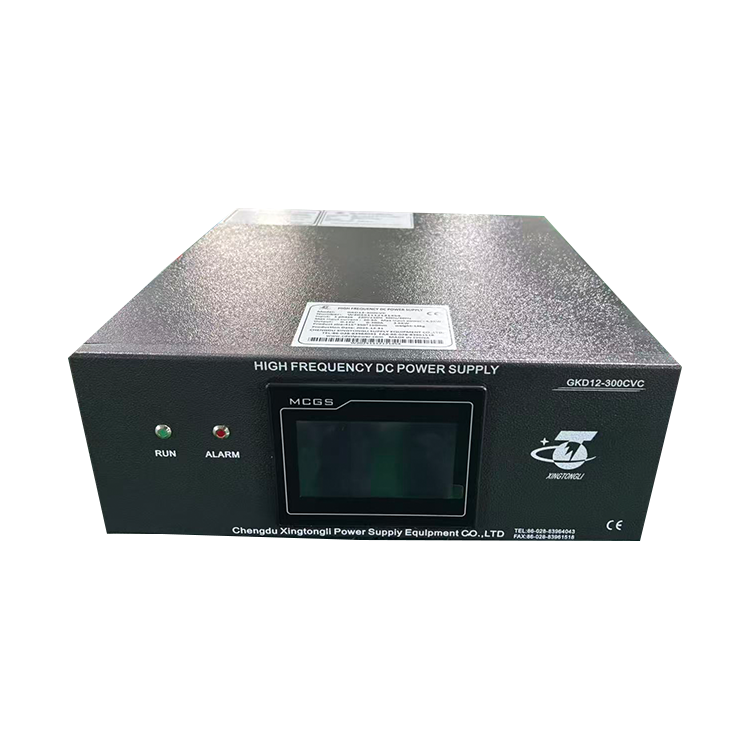
The Human-Machine Interface (HMI) significantly improves usability and on-site management. Through a touch screen, operators can directly set parameters such as current, voltage, ramp-up time, and plating duration. Real-time values are clearly displayed, allowing quick identification of abnormal conditions.
Compared with traditional knob-type rectifiers, HMI-equipped systems simplify training requirements and improve operational efficiency. Process data, alarms, and historical records can be viewed directly on the screen, which helps technicians analyze production issues and optimize plating recipes.
RS485 Communication for Line Integration and Remote Control
RS485 communication enables the rectifier to be integrated into automated electroplating lines and factory control systems. Through standard industrial protocols, the rectifier can exchange data with PLCs, SCADA systems, or central control computers.
This communication capability allows centralized monitoring of multiple rectifiers, synchronized operation with conveyors and tanks, and remote parameter adjustment. In large-scale plating workshops, RS485 networking reduces manual intervention, improves production consistency, and supports digital production management.
Practical Benefits in Electroplating Production
The combination of CPU control, HMI operation, and RS485 communication brings clear practical advantages:
-
Improved coating quality through stable and precise electrical output
-
Reduced setup time and fewer operational errors
-
Enhanced traceability with stored process parameters and historical data
-
Easier integration into automated and intelligent production lines
-
Lower maintenance costs due to fault diagnostics and alarm functions
CPU + HMI + RS485 integrated rectifiers represent a key development direction for the electroplating industry. By combining precise digital control, user-friendly operation, and reliable communication, these rectifiers help electroplating manufacturers achieve higher product quality, better production efficiency, and a more standardized process management system. As electroplating continues to move toward automation and intelligent manufacturing, such rectifiers will play an increasingly important role.
Post time: Jan-30-2026


